From ARPANET to the Internet - a personal journey: An Australian Journey
By Mark Bourne
7. Meanwhile, on the Other Side of the World
By the mid-to-late 1980s, I was studying for a BSc majoring in Computer Science at the University of Tasmania in Hobart.
Geographically, Tasmania could hardly have been further removed from the original ARPANET research centres in California and Utah. Yet we were experiencing the consequences of the same networking revolution.
The computers were different from today's machines. The interfaces were different. The communications links were dramatically slower. Networking was also far more visible to the user.
Today, someone opens a browser and enters a name. The Domain Name System and multiple layers of infrastructure take care of most of what happens next. As students, we were much closer to the machinery.
In our classes, we used IP addresses rather than domain names. A remote computer was not an abstract service hidden behind a polished website. It was a machine somewhere else on a network, identified by a numerical address.
There was no World Wide Web, Google, modern search engine or graphical browser presenting the Internet as an apparently seamless information space. We were dealing with the network much more directly. That gave us a very different appreciation of what computer networking actually meant.
8. Australia Did Not Need ARPANET
This Australian experience illustrates a point sometimes lost in simplified histories of the Internet.
Australia did not need ARPANET to extend a cable all the way to Tasmania. The University of Tasmania did not need to become an ARPANET node. Instead, Australia developed its own academic networking infrastructure.
One particularly important development was ACSNet — the Australian Computer Science Network. ACSNet emerged during the early 1980s and linked Australian universities and computer science departments. The communications infrastructure available in Australia imposed practical constraints, and dial-up telecommunications and other links played an important role.
By today's standards, this infrastructure would seem extraordinarily limited. But the significance was not raw speed. It was connectivity.
Australian researchers could exchange information electronically and participate in a growing networked academic community. ACSNet also provided gateways to international academic networks. That meant researchers at institutions such as the University of Tasmania could communicate beyond Australia even though Tasmania had no ARPANET node and Australia did not participate in ARPANET in the same way as major American research institutions.
This demonstrates the Internet principle beautifully:
A network did not have to become ARPANET. It needed a way to communicate with other networks.
9. UTAS → ACSNet → AARNet → Internet
The broad progression for a university such as UTAS can be represented like this:
UTAS computing → dial-up academic networking → ACSNet → international network gateways → AARNet (1989) → global Internet
Each stage represents more than faster communications. It represents increasing interconnection.
Initially, computing resources were largely local. Academic networking allowed remote systems to communicate. ACSNet connected Australian computer science communities. International gateways extended that communication overseas.
Then came another major change. In 1989, AARNet — the Australian Academic and Research Network — was established. AARNet provided Australian universities and research institutions with national networking built around TCP/IP, the same protocol architecture becoming the foundation of the global Internet.
Australia was no longer merely exchanging messages through isolated academic networking arrangements. Its university networks were becoming participants in the expanding TCP/IP Internet.
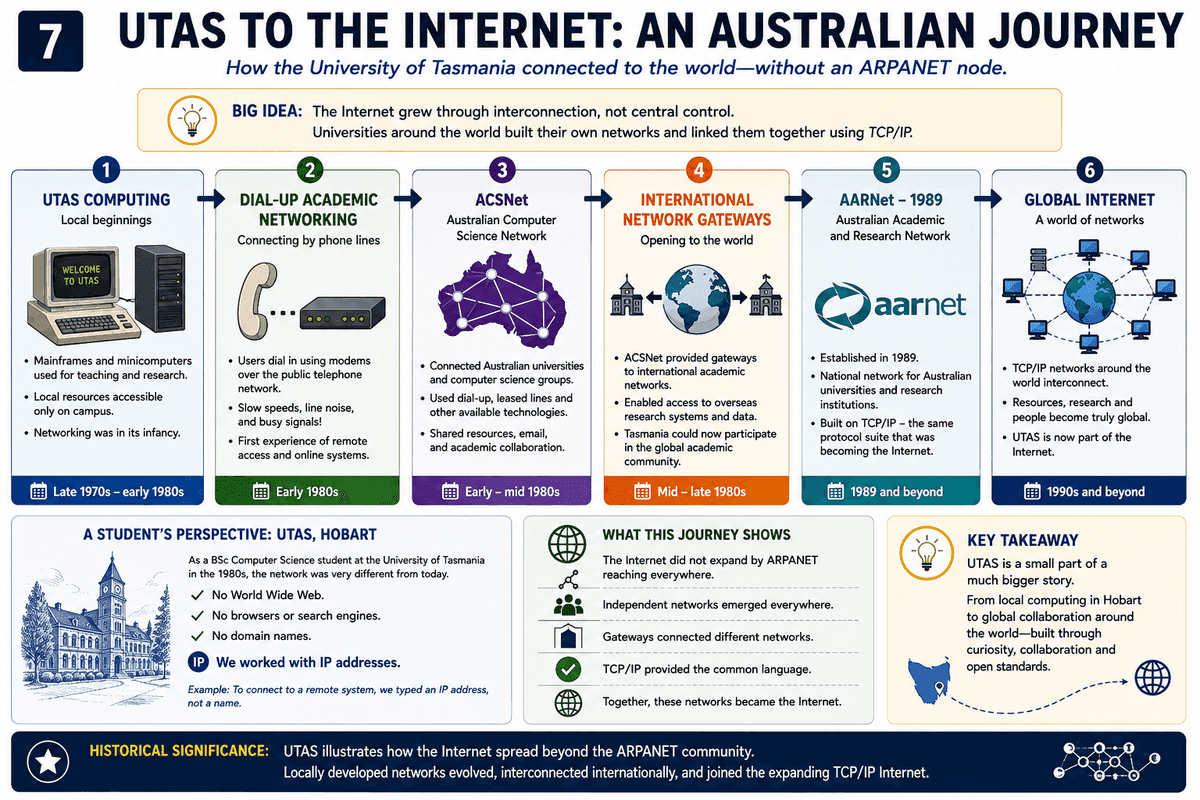
10. A Student's View of the Network
Looking back from today's always-connected world, one detail remains particularly striking: we used IP addresses.
That sounds trivial, but it captures how different the experience was. Today, most people can use the Internet for years without knowing the IP address of a single remote system. DNS, applications and graphical interfaces conceal the infrastructure.
That is exactly what mature infrastructure tends to do. It disappears beneath the services it enables.
But in the mid-to-late 1980s, the network was much more exposed. There was a sense that another machine was actually somewhere else. A numerical network address represented that destination. Connections were more deliberate. Resources were more obviously remote. Networking itself was something Computer Science students needed to understand rather than something that could simply be assumed to exist.
From a teaching perspective, that was valuable. We were seeing computing during the transition from isolated machines towards interconnected systems. We were not merely learning how to operate computers. We were beginning to experience what happened when computers could communicate across institutional and geographic boundaries.
11. DNS Makes the Internet Easier for Humans
Numerical addresses work well for computers. Humans generally prefer names.
As networks expanded, maintaining simple lists mapping computer names to addresses became increasingly impractical. The Domain Name System — DNS — provided a scalable, distributed solution.
Instead of requiring one central computer to maintain every name on the Internet, DNS created a hierarchical naming architecture. Different organisations could administer their own portions of the hierarchy while participating in the global system.
The contrast with my university experience is striking. In our environment, IP addresses were part of interacting with networked systems. Today, DNS normally makes those addresses invisible. A user thinks about a service; the infrastructure determines where that service actually lives.
This was another crucial step in transforming computer networking from a specialist environment into infrastructure that ordinary people could eventually use.
More from the Notes
Short technical notes and observations, written up as experiments produce something worth documenting.
Was this useful?
Published