From ARPANET to the Internet - a personal journey: Architecture, the Web, and the Lesson for AI
By Mark Bourne
12. ARPANET Gives Way to the Internet
By the late 1980s, the networking world had moved well beyond the original ARPANET.
In the United States, NSFNET helped connect supercomputing centres, universities and regional academic networks. Elsewhere, countries and institutions developed their own networking infrastructure. Australia had ACSNet and then AARNet. Other regions followed their own paths.
TCP/IP increasingly provided the common architectural framework connecting these systems.
This leads to one of the most important facts in Internet history:
No single computer became “the Internet.”
There was no master Internet machine. There was no single network into which every other network had to be absorbed. Instead, independently administered networks agreed to communicate using common protocols.
ARPANET itself was decommissioned in 1990. The original experimental network could disappear because the idea it had helped create no longer depended upon it.
That is a remarkable measure of its success.
13. Then Came the World Wide Web
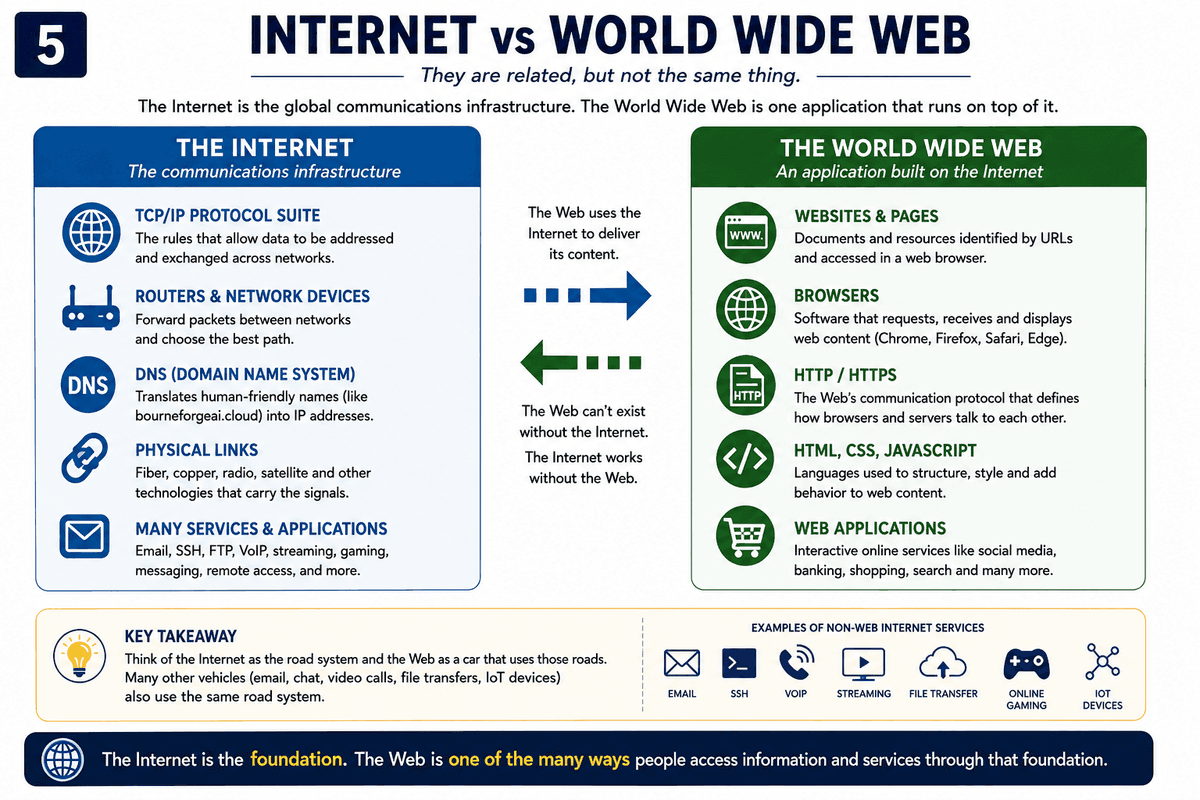
The Internet and the World Wide Web are frequently treated as synonyms. They are not.
The Internet is the networking infrastructure. The Web is an application built on that infrastructure.
Around 1989–1990, Tim Berners-Lee at CERN developed technologies that became fundamental to the World Wide Web, including URLs, HTTP and HTML.
The Web dramatically changed the way ordinary people interacted with the Internet. Information could be represented as interconnected documents. Users could follow hyperlinks. Graphical browsers eventually turned navigation into pointing and clicking. The underlying numerical addressing, routing and packet forwarding became increasingly invisible.
For someone who had used networked university systems in the mid-to-late 1980s, the difference was enormous. The Internet had once presented itself as computers, terminals, commands, network addresses and connections. The Web presented information.
That distinction helped drive the Internet from academia and specialist computing environments into everyday life.
14. Why the Architecture Worked
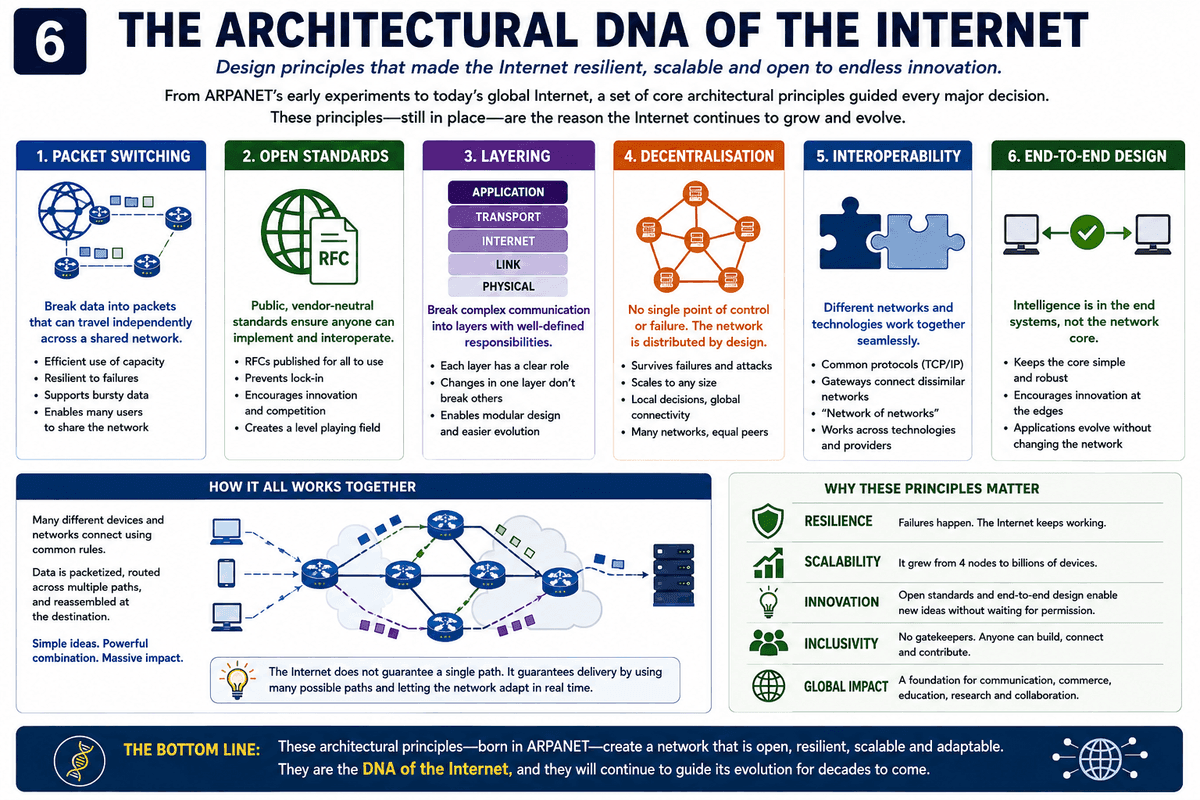
The success of the Internet was not simply the result of faster computers. Its architecture had several characteristics that made enormous growth possible.
- Packet switching — network capacity could be shared efficiently among many communicating systems.
- Open protocols — different vendors and organisations could implement common standards.
- Layering — applications did not need to understand the physical details of every network.
- Decentralisation — no single central computer controlled the entire Internet.
- Interoperability — different network technologies could participate without becoming identical.
- End-to-end communication — much of the intelligence could reside in systems at the edges, leaving the network general enough to support applications not imagined by its original designers.
Together, these principles created something much more powerful than ARPANET alone: an architecture capable of surviving technological change.
15. The Most Important Transition
It is tempting to describe Internet history as a progression of technologies:
ARPANET → TCP/IP → NSFNET and AARNet → Web → broadband → cloud → mobile Internet
That chronology is useful, but it misses the deeper engineering story.
The crucial transition was conceptual.
ARPANET demonstrated that geographically separated computers could communicate effectively through packet switching. Internetworking demonstrated something much bigger:
Independent networks could cooperate without surrendering their independence.
That idea allowed the system to scale beyond any single organisation, telecommunications technology, computer architecture or country.
A university could operate its network. A telecommunications company could operate another. A corporation, home or data centre could operate another. Each network could make many of its own engineering decisions. At their boundaries, common protocols allowed them to communicate.
That is the Internet.
Tasmania provides a particularly clear example. UTAS did not need to join ARPANET. Australian academic networks could develop according to local conditions, connect through international gateways, adopt TCP/IP and become part of a global system.
Conclusion: From Four Nodes to a Global System
In 1969, ARPANET began with four connected research sites.
Today, the Internet connects an extraordinary collection of networks, computers, phones, data centres, satellites, sensors, industrial systems and cloud platforms. The scale has changed almost beyond recognition.
Yet some of the architectural thinking developed during the early networking era remains remarkably visible. Packets still move through interconnected networks. Routers still make forwarding decisions. IP still provides the common internetworking layer. DNS still translates human-readable names. Applications continue to be built above general-purpose network infrastructure.
The enduring achievement of the Internet's pioneers was therefore not simply connecting computers. It was discovering how to build a system in which networks built by different people, for different purposes and using different technologies could cooperate through shared protocols.
ARPANET proved that packet networking could work. TCP/IP provided the architecture for connecting networks. Open standards allowed that architecture to spread. National and academic networks — including ACSNet and AARNet in Australia — demonstrated how independent systems could become part of the whole.
For me, that history also has a human scale. As a Computer Science student at the University of Tasmania in the mid-to-late 1980s, using numerical IP addresses in class, I encountered a small part of the transition firsthand. From Hobart — far from the original ARPANET nodes — we were already becoming participants in the networking revolution those early experiments had helped begin.
And from those ideas emerged something that no single organisation owns and no single machine controls:
the Internet.
Bourne Forge AI — Architecture Perspective
There is also a lesson here for today's AI systems.
Transformative infrastructure rarely succeeds because every component is controlled by one system. It succeeds when components have clear responsibilities, interfaces are well defined, failures can be contained, and new technologies can be introduced without rebuilding everything around them.
The Internet became powerful not because ARPANET grew until it controlled every computer network. It became powerful because ARPANET helped produce architectural ideas that allowed other networks to join.
More than half a century later, that may be one of the most valuable infrastructure lessons the Internet can offer the emerging AI era.
More from the Notes
Short technical notes and observations, written up as experiments produce something worth documenting.
Was this useful?
Published