From ARPANET to the Internet - a personal journey
How an American Research Experiment Became a Global Network of Networks — and Reached a Computer Science Student in Tasmania
By Mark Bourne
Today, connecting to the Internet feels almost effortless.
A phone joins Wi-Fi. A laptop opens a website hosted on another continent. An email crosses the world in seconds. A video call passes through networks operated by numerous organisations, yet the participants usually have no idea which networks their data has crossed.
That apparent simplicity hides one of the great engineering achievements of the twentieth century.
The Internet did not begin as a worldwide network. It began as an experiment.
In the late 1960s, researchers funded by the United States Advanced Research Projects Agency created ARPANET, a packet-switched network designed to allow computers at different research institutions to communicate.
ARPANET was revolutionary. But ARPANET was not yet the Internet.
The much bigger breakthrough came when researchers began asking a different question:
How can completely different computer networks communicate with each other while remaining independent networks?
Solving that problem led to TCP/IP and ultimately to the architecture of the modern Internet.
For me, this is not entirely abstract history.
In the mid-to-late 1980s, I was studying for a Bachelor of Science degree, majoring in Computer Science, at the University of Tasmania in Hobart. By then, the networking revolution that had begun with experiments such as ARPANET was reaching universities on the other side of the world.
We had no Web. We had no graphical browsers. And in the systems we used in our classes, we did not navigate the network using convenient domain names.
We used IP addresses.
Looking back, that experience provides a small Australian window into a much larger story: how ARPANET helped establish the ideas and technologies that allowed thousands of independently developed networks to become the Internet.
1. Before ARPANET: Computers Were Islands
Computers in the 1960s bore little resemblance to today's personal machines. They were large, expensive systems generally operated by universities, government agencies and major corporations. Access was scarce, computing resources were precious, and machines at different institutions normally existed as isolated systems.
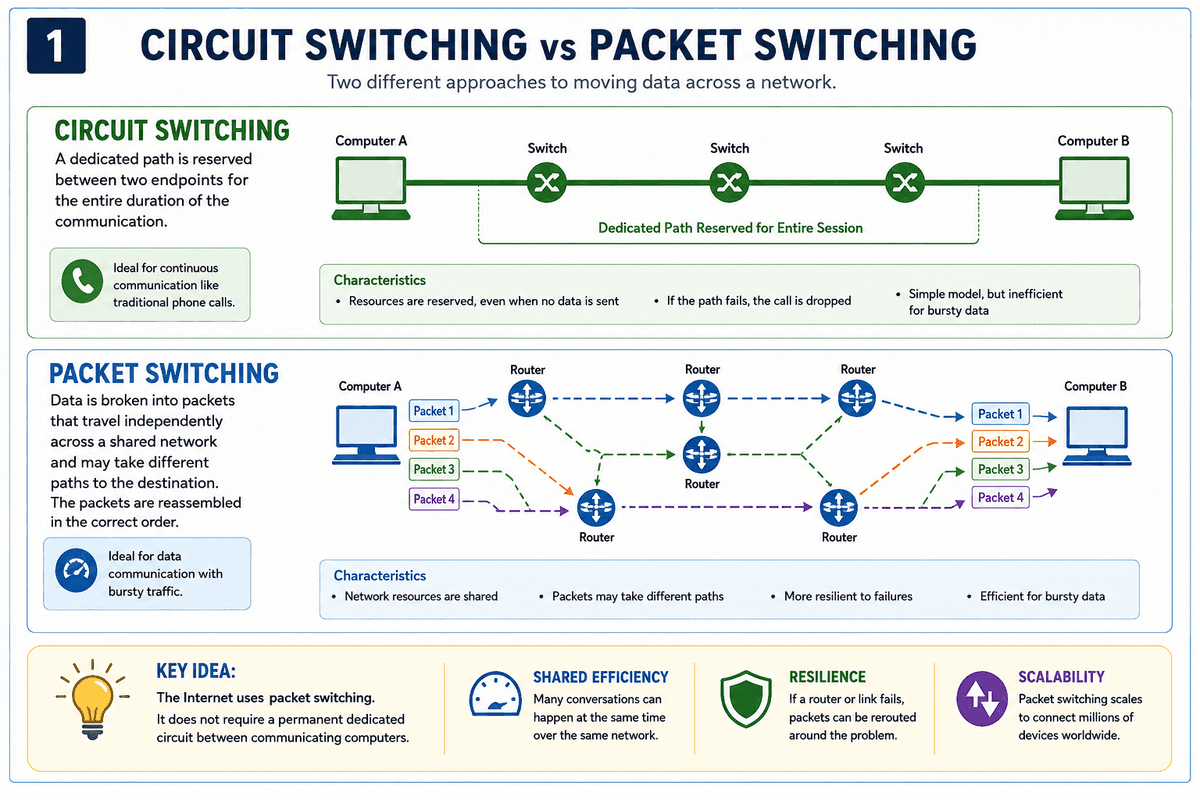
The dominant global communications infrastructure was the telephone network, which was designed around circuit switching. When a traditional telephone call was established, network resources were reserved to create a communications path between the two endpoints for the duration of the conversation.
That approach worked extremely well for voice. Computers presented a different problem.
Computer communication is frequently bursty. A computer might transmit information for a fraction of a second, remain silent, and then transmit another block later. Keeping an entire communications circuit reserved during those periods of silence was inefficient.
Researchers including Paul Baran in the United States and Donald Davies in Britain explored a radically different approach. Instead of treating a communication as one continuous stream requiring a dedicated circuit, information could be divided into smaller units. Those units could travel independently through a shared communications network and be reconstructed at their destination.
The idea became known as packet switching. It would become one of the foundations of modern computer networking.
2. ARPANET: The Experiment Begins
The Advanced Research Projects Agency — ARPA — was interested in improving access to expensive computing resources at American research institutions. The result was ARPANET.
Rather than requiring the large host computers themselves to perform every networking function, ARPANET used specialised packet-switching computers called Interface Message Processors, or IMPs. Conceptually, an IMP performed some of the functions we would later associate with network routers. A host computer connected to an IMP, and the IMP handled communication across the packet-switched network.
In 1969, the first ARPANET nodes were installed at four sites:
- UCLA
- Stanford Research Institute
- UC Santa Barbara
- University of Utah
On 29 October 1969, UCLA attempted to send a message to Stanford Research Institute. The intended message was LOGIN. The remote system failed after the first two characters had been transmitted, so one of the most consequential computer networks ever constructed began with the message LO.
It was an appropriately modest beginning.
ARPANET expanded during the 1970s as additional universities and research organisations joined. But an important distinction needs to be made:
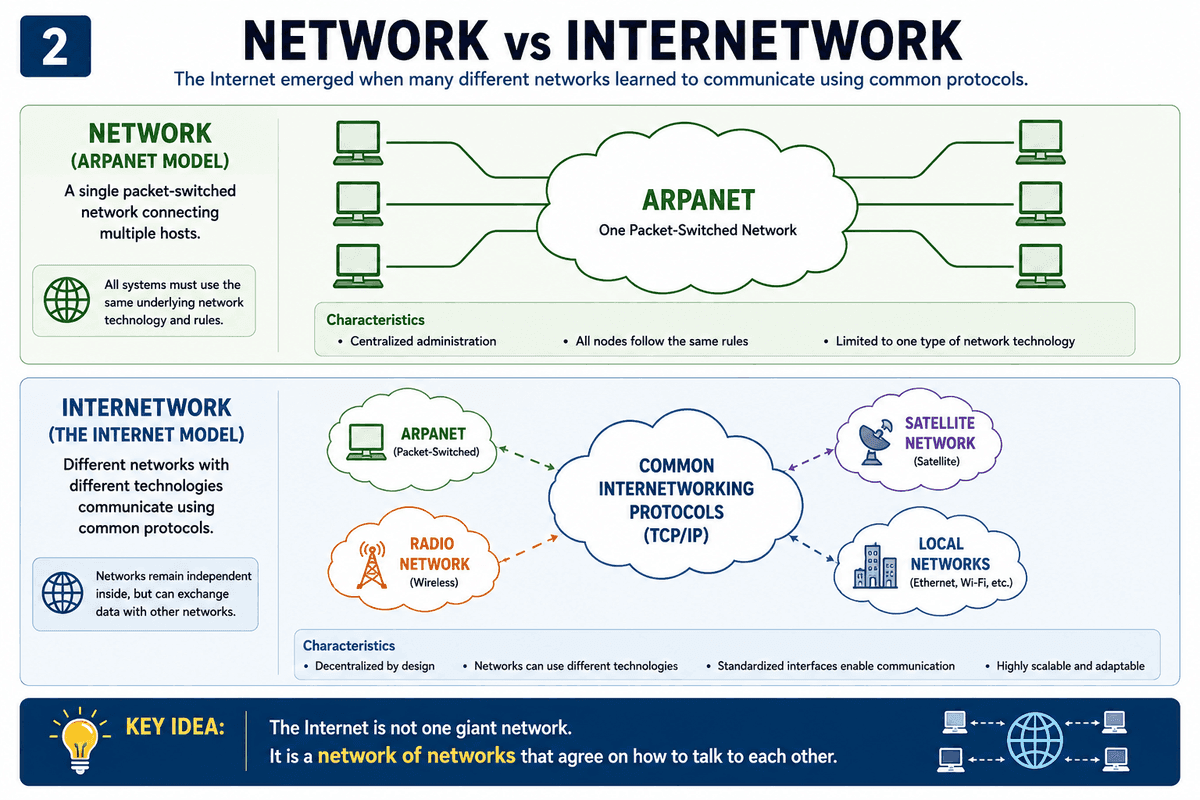
ARPANET was a network. The Internet would become a network of networks.
That distinction is the key to understanding everything that followed.
3. From Networking to Internetworking
As computer networking research expanded, ARPANET was no longer the only network being developed. Researchers were experimenting with packet radio systems, satellite communications and different types of local networks.
These systems had very different characteristics. A radio network did not behave like a wired network. A satellite link introduced different delays and constraints. Local networks were developing their own technologies.
One possible solution would have been to force every participating organisation to adopt one common underlying network. That would have been extraordinarily limiting.
Instead, a much more powerful idea emerged:
Allow individual networks to remain different internally while giving them a common mechanism for communicating with each other.
This was the conceptual leap from networking to internetworking. It is also the idea that ultimately explains how a university in Tasmania could become part of the same global system whose technological roots included ARPANET.
4. Cerf, Kahn and TCP/IP
During the 1970s, Vint Cerf and Bob Kahn worked on the protocols necessary to make this network-of-networks architecture practical. Their work contributed to what eventually became the TCP/IP protocol suite.
The architecture separated responsibilities. At a simplified level, the Internet Protocol — IP — provides addressing and packet delivery across interconnected networks. TCP — the Transmission Control Protocol — can provide reliable end-to-end communication for applications that require it.
That separation proved enormously important.
Applications did not need to understand the physical construction of every network between two computers. The underlying networks did not need to understand everything the applications were doing. Different layers had different responsibilities.
This meant that technologies could evolve independently. Ethernet could change. Radio communications could change. Computers, transmission speeds and applications could all change. Yet communication could continue as long as systems supported the agreed interfaces and protocols.
That is one of the great architectural achievements of the Internet.
5. Gateways: Connecting Networks Without Making Them Identical
Independent networks needed a way to exchange packets. Early Internet architecture used the term gateway for systems performing functions that would increasingly be associated with routers.
A packet might travel like this:
Computer → local network → router → ISP network → Internet backbone → another router → remote network → destination computer
The packet may cross several completely different physical technologies during that journey: copper, fibre, radio, satellite, Ethernet and Wi-Fi. The application generally does not need to know. IP provides the common internetworking layer.
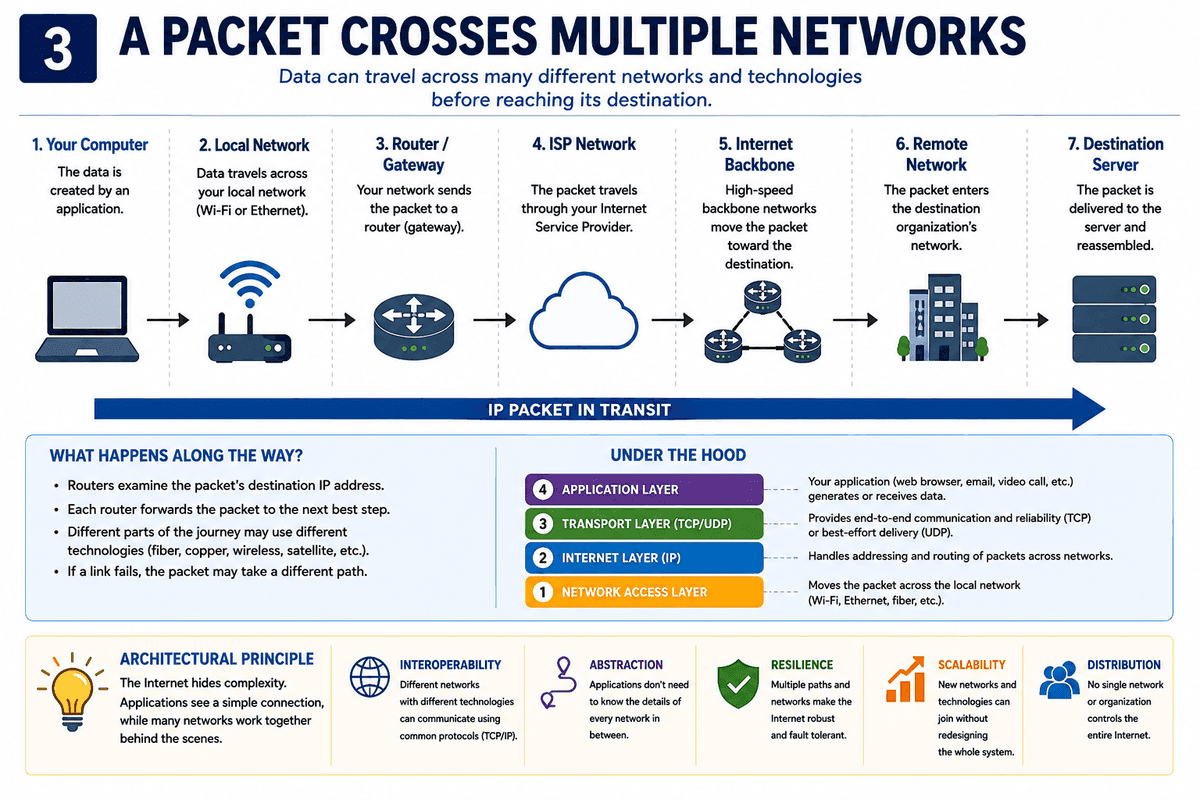
The important principle is not that every network is identical. It is almost the opposite: standardise the interfaces sufficiently to permit interoperability while allowing the individual systems behind those interfaces to evolve independently.
6. January 1, 1983: TCP/IP Becomes Operational
ARPANET originally used a protocol called the Network Control Protocol, or NCP. As the internetworking architecture matured, TCP/IP became its successor.
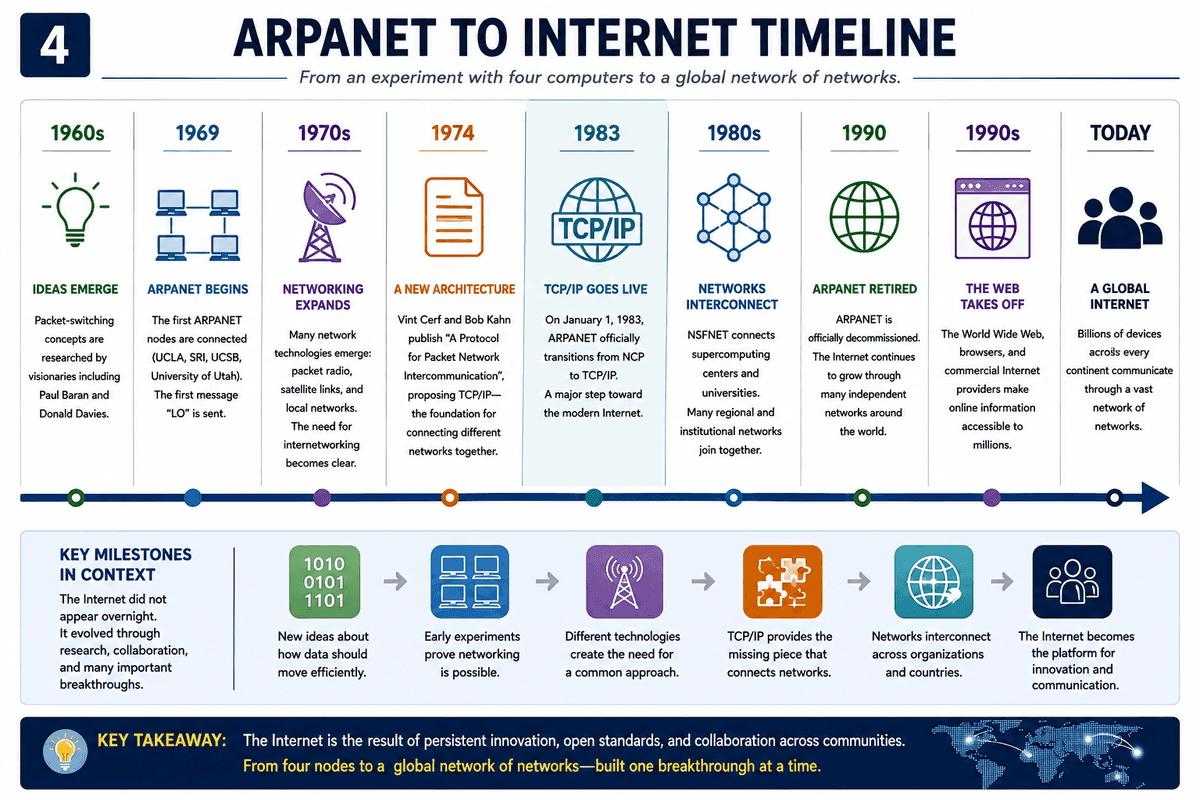
A major transition occurred on 1 January 1983, when ARPANET hosts moved from NCP to TCP/IP. This date is sometimes described as the birth of the Internet.
As with most major technological transitions, reality was more gradual. The Internet was not invented on one particular morning. It evolved through decades of research, experimentation, implementation and standardisation.
Nevertheless, 1983 remains a critical milestone. TCP/IP was no longer merely an interesting research proposal. It was becoming the common architecture through which operational networks could interconnect.
The Internet was taking shape.
More from the Notes
Short technical notes and observations, written up as experiments produce something worth documenting.
Was this useful?
Published