The Future of AI Workflows: From Prompt Engineers to AI Systems Architects
By Mark Bourne
“As models become more capable, the value shifts from telling the AI exactly what to do toward designing the system in which the AI operates.”
The current generation of artificial intelligence is often described through the language of prompts.
We write prompts.
We refine prompts.
We collect prompt templates.
We discuss prompt engineering.
That terminology makes sense because conversational interfaces have been the primary way most people first encountered large language models.
But it may also describe a transitional period.
The history of computing repeatedly shows that as technologies mature, attention moves upward through layers of abstraction.
Early networking required detailed knowledge of hardware and protocols.
Later, increasingly sophisticated infrastructure allowed engineers to concentrate on applications and architecture.
Early programming required direct interaction with hardware.
Assemblers, compilers, operating systems, frameworks, libraries, and cloud platforms progressively moved developers toward higher levels of abstraction.
Artificial intelligence appears to be following a similar path.
Today’s prompt engineering may eventually become just one low-level component of a much larger discipline:
AI systems architecture.
The Prompt Is Becoming an Interface
A useful way to think about prompts is as an interface between human intent and machine capability.
Today that interface is highly visible.
Users carefully specify:
- roles,
- context,
- objectives,
- constraints,
- formats,
- examples,
- review criteria.
As AI systems improve, much of this explicit instruction may become unnecessary.
A sufficiently capable system should increasingly infer:
- what information is relevant,
- which tools are required,
- what steps are necessary,
- where uncertainty exists,
- when additional information should be requested,
- and when human approval is appropriate.
This does not mean prompting disappears.
It means prompting becomes less central.
The user increasingly defines the objective.
The system increasingly determines how to achieve it.
From Instructions to Intent
Consider the difference between these two approaches.
Today’s interaction might require:
Analyse these requirements. Create an architecture. Identify risks. Compare three implementation approaches. Recommend one. Create an implementation plan. Review the plan for security weaknesses.
A more advanced AI system may eventually require only:
Design a secure production architecture for this application.
The system could determine that achieving this objective requires:
- 1Understanding requirements.
- 2Identifying missing information.
- 3Retrieving relevant documentation.
- 4Exploring alternatives.
- 5Evaluating security.
- 6Comparing costs.
- 7Producing recommendations.
- 8Requesting human approval.
The workflow still exists.
The difference is that the workflow is increasingly orchestrated by the AI itself.
This distinction is important.
Better models do not eliminate workflows. They absorb parts of them.
The Rise of AI Agents
One of the most significant developments in AI is the transition from models that primarily answer questions toward systems capable of performing sequences of actions.
These systems are commonly described as agents.
The terminology is still evolving, but the underlying concept is straightforward.
A traditional chatbot might:
Receive request → Generate response.
An agentic system might:
Receive objective → Plan → Use tools → Observe results → Adapt → Continue → Request approval → Complete task.
That creates a fundamentally different interaction model.
Instead of merely generating information, AI begins participating directly in workflows.
An agent might:
- inspect source code,
- modify files,
- execute tests,
- analyse failures,
- revise code,
- check documentation,
- prepare a deployment,
- and ask for approval before production changes.
The conversational model becomes an operational model.
Autonomy Changes the Risk Model
Greater capability does not automatically produce greater reliability.
In fact, increasing autonomy can amplify mistakes.
Consider the difference between an AI suggesting a command and an AI executing it.
If the recommendation is wrong, the first system produces incorrect text.
The second may alter a real environment.
The potential consequences are very different.
This leads to an important principle:
The greater the autonomy, the stronger the controls should become.
Agentic workflows therefore require concepts familiar to infrastructure and security engineers:
- least privilege,
- authentication,
- authorisation,
- logging,
- monitoring,
- rollback,
- isolation,
- approval gates,
- change control,
- failure recovery.
These are not new problems.
They are familiar engineering problems appearing in a new environment.
AI Needs Boundaries
A capable AI system should not necessarily have access to everything it could theoretically use.
Imagine an AI coding agent.
It might need:
- read access to source code,
- permission to modify a development branch,
- permission to run tests.
Does it also need unrestricted production access?
Probably not.
The principle of least privilege applies naturally.
Give the AI the minimum access required to complete its assigned task.
This reduces the blast radius when something goes wrong.
The same principle has protected computer systems for decades.
There is little reason to abandon it simply because the actor requesting access happens to be artificial intelligence.
Observability Will Become Essential
Traditional software systems generate telemetry.
We monitor:
- logs,
- errors,
- latency,
- resource utilisation,
- availability,
- transactions.
AI workflows require their own forms of observability.
Useful questions include:
- What information did the AI receive?
- Which tools did it use?
- What assumptions did it make?
- Where did a failure occur?
- Which actions required retries?
- How often did humans override recommendations?
- Which workflow stages generate the most errors?
Without observability, failures become difficult to diagnose.
And if failures cannot be diagnosed, systems cannot be systematically improved.
This is another reason workflow engineering matters.
A workflow creates identifiable stages.
Identifiable stages can be measured.
Measured stages can be improved.
AI Systems Need Failure Domains
Internet architecture has long relied on the concept of limiting failure.
A problem in one component should not automatically destroy the entire system.
AI systems should be designed similarly.
Suppose an AI workflow performs:
Research → Analysis → Recommendation → Implementation.
If research fails, should implementation continue automatically?
Probably not.
A well-designed workflow establishes checkpoints.
If confidence falls below an acceptable level, the workflow can:
- stop,
- retry,
- request more information,
- use an alternative source,
- escalate to a human.
This is graceful degradation applied to AI.
Instead of assuming intelligence eliminates failure, architecture assumes failure will occur and designs accordingly.
Human Approval Becomes More Important, Not Less
There is an understandable assumption that increasingly capable AI will progressively remove humans from workflows.
In some routine activities, that will happen.
But in consequential systems, human involvement may become more important precisely because AI can do more.
The critical question becomes:
Where should humans remain in control?
Not every decision requires approval.
Requiring a person to approve every minor action would eliminate much of the benefit of automation.
Instead, approval should be proportional to consequence.
For example:
Low consequence:
- formatting documentation,
- organising notes,
- generating test data.
Moderate consequence:
- modifying application code,
- updating configuration,
- preparing infrastructure changes.
High consequence:
- production deployment,
- deleting data,
- modifying security policies,
- approving financial transactions.
This creates a risk-based approach to human oversight.
The Importance of Reversibility
One particularly useful engineering principle for AI systems is reversibility.
Before allowing an automated action, ask:
If this goes wrong, how easily can it be undone?
This simple question changes workflow design.
- 1For software: Use version control.
- 2For infrastructure: Maintain previous configurations.
- 3For documents: Preserve revision history.
- 4For databases: Maintain backups and transaction controls.
- 5For deployments: Provide rollback procedures.
Reversible actions can often tolerate greater automation.
Irreversible actions deserve stronger controls.
This principle provides a practical bridge between AI autonomy and operational safety.
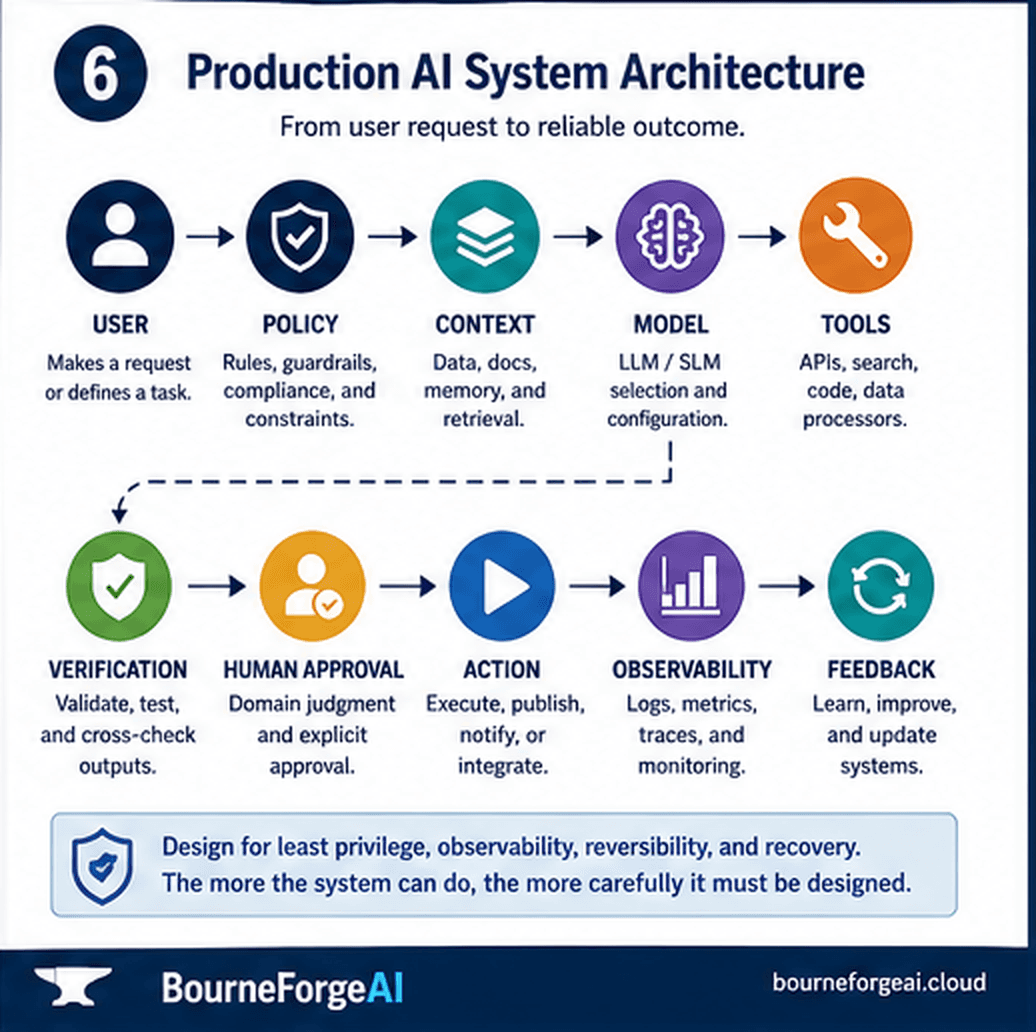
AI Orchestration
As organisations adopt multiple AI models, tools, databases, and agents, another layer becomes increasingly important:
orchestration.
An orchestrator determines how work moves through the system.
For example:
- 1User request
- 2Classify task
- 3Retrieve relevant context
- 4Select appropriate model
- 5Generate candidate response
- 6Run verification
- 7Escalate if necessary
- 8Human approval
- 9Execute action
- 10Record outcome
At this point, the prompt is only one small component.
The architecture becomes the dominant concern.
About This Book
This page is part of Prompt and Workflow Experiments: What Actually Improves AI Results?, an eight-chapter deep dive on reliable AI engineering.
More from the Notes
Short technical notes and observations, written up as experiments produce something worth documenting.
Was this useful?
Published