Building an AI Evaluation Framework: From Opinions to Evidence
By Mark Bourne
“What gets measured gets improved. What gets compared thoughtfully becomes understood.”
One of the defining characteristics of mature engineering disciplines is that they rely on frameworks rather than intuition.
Civil engineers do not judge a bridge by appearance alone.
Network engineers do not evaluate routing protocols based on personal preference.
Software architects do not choose databases because they “feel faster.”
Instead, they establish objectives, define evaluation criteria, perform controlled testing, document observations, and refine their decisions over time.
Artificial intelligence deserves the same disciplined approach.
Unfortunately, much of today’s AI discussion is driven by anecdotal experience.
People often say:
- “This model feels smarter.”
- “I liked the response.”
- “It seemed more creative.”
- “That prompt worked really well.”
These impressions are valuable starting points, but they are not reliable evaluation methods.
Professional practice requires something more structured.
It requires a framework.
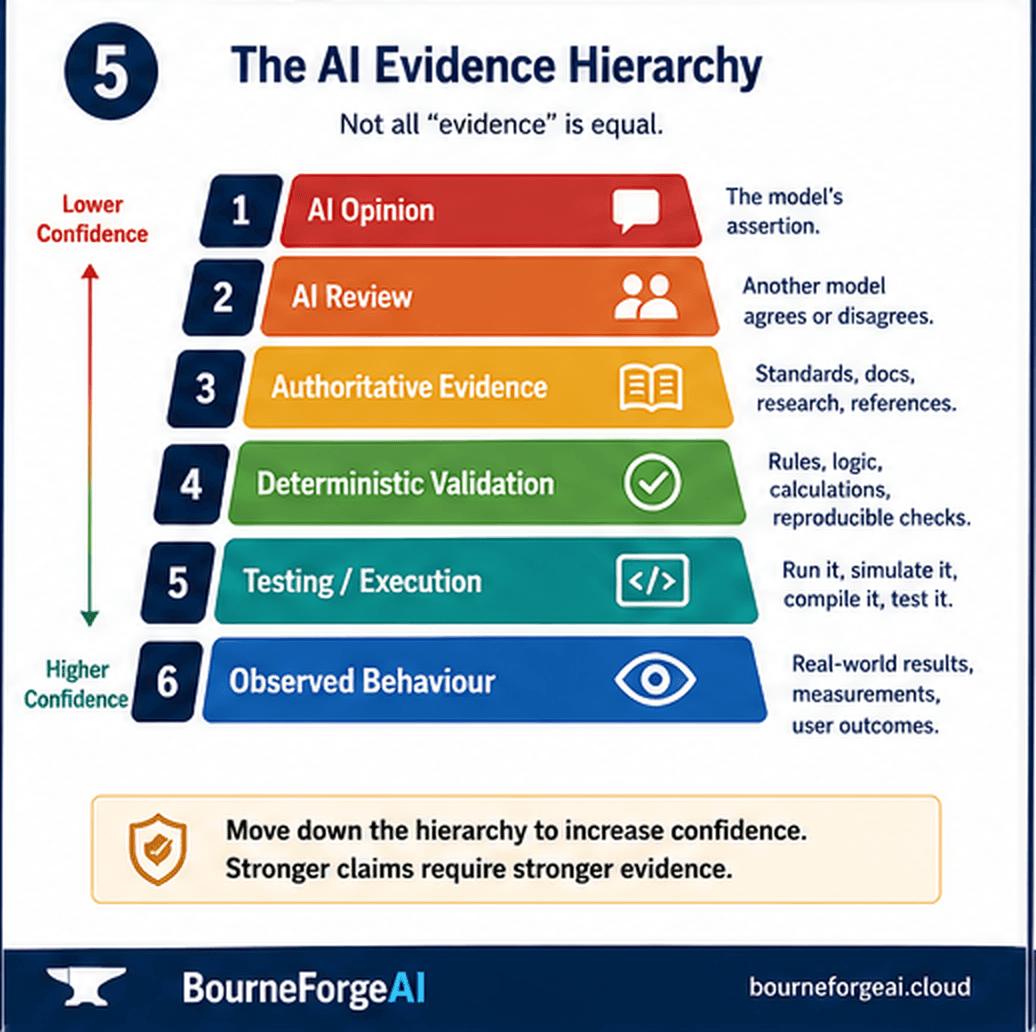
Why Frameworks Matter
Imagine asking ten people to review the same AI-generated article.
Without agreed criteria, each reviewer will focus on different aspects.
One values creativity.
Another values factual accuracy.
A third prefers concise writing.
A fourth dislikes technical language.
Each opinion is valid.
None of them alone provides a complete evaluation.
Frameworks solve this problem by defining what success looks like before testing begins.
Instead of asking:
“Do I like this answer?”
we ask:
“Does this answer satisfy the objectives we established?”
That simple change transforms subjective impressions into evidence-based assessments.
Step 1 – Define the Objective
Every evaluation begins with a clearly stated objective.
This sounds obvious, yet it is one of the most frequently overlooked steps.
For example:
Poor objective:
Write something about cybersecurity.
Better objective:
Produce a technical article explaining ransomware protection for small business owners with limited IT experience.
Notice how the second objective defines:
- Topic,
- Audience,
- Technical depth,
- Purpose.
Without a clear objective, meaningful evaluation becomes impossible.
Step 2 – Identify Success Criteria
Once the objective is defined, decide how success will be measured.
A useful evaluation framework separates quality into multiple dimensions.
For BourneForgeAI, the following criteria have proven practical across many different tasks.
Accuracy
- Are factual statements correct?
- Does technical advice align with current best practice?
- Were unsupported claims introduced?
Completeness
- Does the response cover the important aspects of the problem?
- Were obvious omissions left unexplored?
Clarity
- Would the intended audience understand the explanation?
- Are concepts introduced logically?
- Is unnecessary jargon avoided?
Structure
- Does the response flow naturally?
- Are sections organised coherently?
- Can readers easily locate information?
Practical Value
- Can the output be used?
- Does it assist decision-making?
- Does it suggest realistic next steps?
Consistency
- Would repeating the experiment produce similar quality?
- Or is the result largely dependent on chance?
Step 3 – Identify Risks
One area often ignored in AI evaluations is risk.
Infrastructure engineers routinely analyse failure modes before systems are deployed.
AI workflows benefit from exactly the same thinking.
Ask questions such as:
What could go wrong?
Examples include:
- Fabricated information,
- Outdated knowledge,
- Misleading certainty,
- Incomplete reasoning,
- Hidden assumptions,
- Security oversights,
- Bias,
- Ambiguous recommendations.
Risk analysis changes the conversation from:
“How impressive is this answer?”
to:
“Under what circumstances could this answer fail?”
That is a far more valuable question.
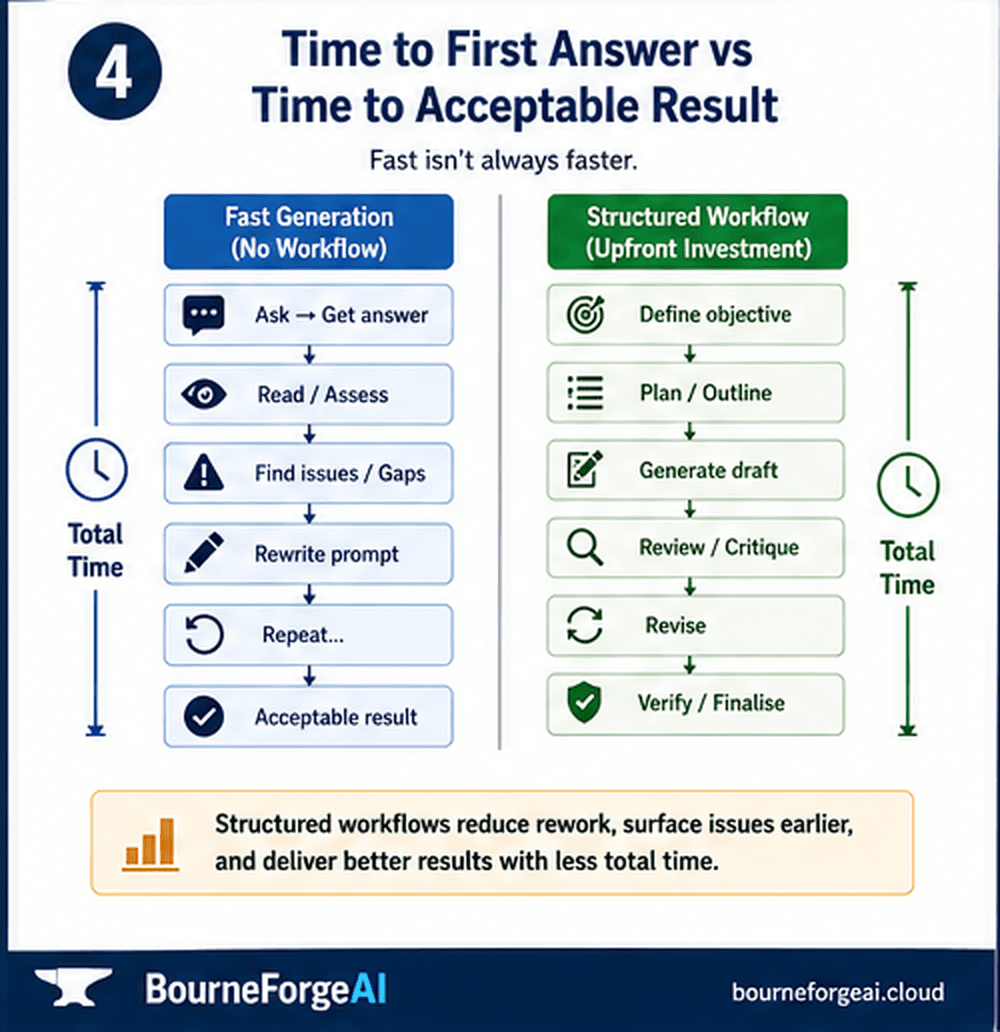
Step 4 – Evaluate the Process, Not Just the Output
A common mistake is judging only the final response.
Imagine two workflows.
Workflow A: Produces an excellent answer after six revisions.
Workflow B: Produces an equally good answer after two revisions.
Which workflow is better?
For most professional environments, Workflow B.
Why?
Because productivity matters.
Evaluation should therefore include process metrics such as:
- Time required,
- Number of iterations,
- Amount of human editing,
- Frequency of factual corrections,
- Ease of refinement.
Sometimes an average first draft with an efficient workflow outperforms a brilliant draft that requires extensive manual repair.
Step 5 – Document Observations
Memory is unreliable.
Documentation is not.
Each experiment should produce a brief record.
For example:
| Field | Value |
|---|---|
| Objective | Create a beginner's networking guide. |
| Workflow | Outline → Draft → Review → Edit. |
| Model | Claude |
| Strengths | Excellent structure. |
| Weaknesses | Several networking terms assumed prior knowledge. |
| Improvement | Add audience reminder before drafting. |
Repeat this process consistently and something interesting happens.
Patterns emerge.
Certain prompt structures repeatedly improve clarity.
Certain workflows reduce hallucinations.
Certain review stages consistently identify technical mistakes.
Over time, the workflow becomes smarter.
Step 6 – Refine Incrementally
Many users redesign their entire prompting strategy after every experiment.
Experienced practitioners do the opposite.
Small improvements accumulate.
Perhaps today's experiment reveals that asking for an outline first improves document quality.
Tomorrow's experiment introduces independent review.
Next week's experiment compares different editing workflows.
Each refinement becomes part of a growing system.
The objective is continuous improvement rather than dramatic reinvention.
Evaluating the Workflow Itself
One of BourneForgeAI’s guiding principles is that workflows deserve evaluation just as much as AI models.
Questions worth asking include:
- Does this workflow consistently produce high-quality work?
- Could another person reproduce these results?
- Is every stage necessary?
- Where does most human effort occur?
- Which stages benefit most from AI?
- Which stages require human judgement?
These questions often reveal that improving the workflow yields larger gains than changing prompts.
A Practical BourneForgeAI Evaluation Matrix
The following matrix provides a simple but effective framework for evaluating AI-assisted work.
| Dimension | Questions |
|---|---|
| Objective | Was the original goal clearly defined? |
| Context | Did the AI receive sufficient relevant information? |
| Prompt Design | Was the instruction appropriate for the task? |
| Workflow | Was the task divided into logical stages? |
| Accuracy | Were technical claims verified? |
| Completeness | Were important topics omitted? |
| Human Review | Were critical decisions independently checked? |
| Repeatability | Can the same process reliably produce similar quality? |
| Improvement | What should change next time? |
This matrix deliberately evaluates more than the prompt.
It evaluates the entire production system.
Case Study — Evaluating an AI-Written Article
Suppose two AI-generated articles appear equally polished.
Traditional evaluation might simply ask:
Which one reads better?
Using the BourneForgeAI framework, the assessment becomes much richer.
Questions include:
- Was the target audience correctly identified?
- Were technical statements verified?
- Did the workflow include editorial review?
- Could another writer reproduce the same result?
- Were unsupported assumptions introduced?
- How many revisions were required?
- Which workflow was easier to maintain?
Notice how the discussion shifts from opinion toward evidence.
Building Organisational Knowledge
Individual experiments are useful.
Shared experiments are transformative.
Teams that document successful workflows gradually build institutional knowledge.
Instead of relying on one person’s experience, the organisation develops:
- Reusable prompt libraries,
- Proven workflow templates,
- Evaluation checklists,
- Quality standards,
- Review procedures,
- Lessons learned.
Over time, AI use becomes increasingly predictable.
This is exactly how mature engineering organisations evolve.
Thinking in Feedback Loops
Perhaps the most important characteristic of effective workflows is that they learn.
Each project produces new information.
That information improves future projects.
The cycle looks something like this:
- 1Plan.
- 2Generate.
- 3Review.
- 4Measure.
- 5Improve.
- 6Repeat.
This feedback loop mirrors the continuous improvement processes used throughout engineering, manufacturing, software development, and scientific research.
Artificial intelligence should be treated no differently.
Key Takeaways
The quality of AI-assisted work depends less on finding perfect prompts and more on building repeatable evaluation frameworks.
By defining objectives, establishing measurable criteria, documenting observations, analysing risks, and refining workflows incrementally, AI use becomes increasingly reliable.
Rather than asking whether an AI produced an impressive answer, experienced practitioners ask a more important question:
Can this process consistently produce high-quality work again tomorrow?
That is the hallmark of an engineering mindset.
And it is the foundation upon which trustworthy AI workflows are built.
About This Book
This page is part of Prompt and Workflow Experiments: What Actually Improves AI Results?, an eight-chapter deep dive on reliable AI engineering.
More from the Notes
Short technical notes and observations, written up as experiments produce something worth documenting.
Was this useful?
Published