Workflow Engineering: Designing Systems Instead of Conversations
By Mark Bourne
“A great prompt can improve one answer. A great workflow can improve every answer.”
If prompt engineering is about improving individual interactions with AI, workflow engineering is about improving the entire process from beginning to end.
This distinction may appear subtle, but it represents one of the most significant shifts in how experienced AI practitioners work.
Beginners often think in terms of conversations.
Experts think in terms of systems.
The conversation is simply one component within that system.
From Chatbot to Collaborative Tool
One of the reasons AI is frequently underestimated is that it is presented through a chat interface.
A chat window encourages a conversational mindset:
- Ask a question.
- Receive an answer.
- Ask another question.
- Continue until finished.
While this interaction model is intuitive, it can also be limiting.
Professional work rarely follows such a linear path.
Consider the process of producing a technical white paper, designing a cloud architecture, or writing production software. These tasks involve planning, research, review, iteration, validation, and refinement. Each stage has different objectives and different success criteria.
When viewed through this lens, AI is no longer a chatbot.
It becomes one component within a structured workflow.
Defining a Workflow
A workflow is a repeatable sequence of activities designed to achieve a consistent outcome.
In AI-assisted work, those activities may involve both human judgement and AI-generated content.
A simple workflow for writing documentation might look like this:
- 1Define the audience.
- 2Clarify the objective.
- 3Gather source material.
- 4Generate an outline.
- 5Review and revise the outline.
- 6Expand each section.
- 7Verify technical accuracy.
- 8Improve readability.
- 9Edit for consistency.
- 10Publish.
Notice that the AI contributes at several stages, but it does not replace the workflow itself.
Each step builds on the previous one.
Each review improves confidence.
Each iteration reduces the likelihood of errors.
Why Single-Prompt Solutions Often Disappoint
Suppose someone asks an AI:
“Write a comprehensive guide to Docker networking.”
The response may be impressive.
It may also contain:
- missing topics,
- uneven structure,
- unnecessary repetition,
- unsupported technical claims,
- assumptions about the audience,
- inconsistent terminology.
None of these issues necessarily indicate that the AI failed.
Instead, they reflect the limitations of asking a single prompt to perform the work of an entire editorial process.
Experienced users break the task into manageable stages because different cognitive activities benefit from different prompts.
Planning is different from writing.
Writing is different from editing.
Editing is different from fact-checking.
By separating these activities, each prompt has a narrower objective and therefore produces more reliable results.
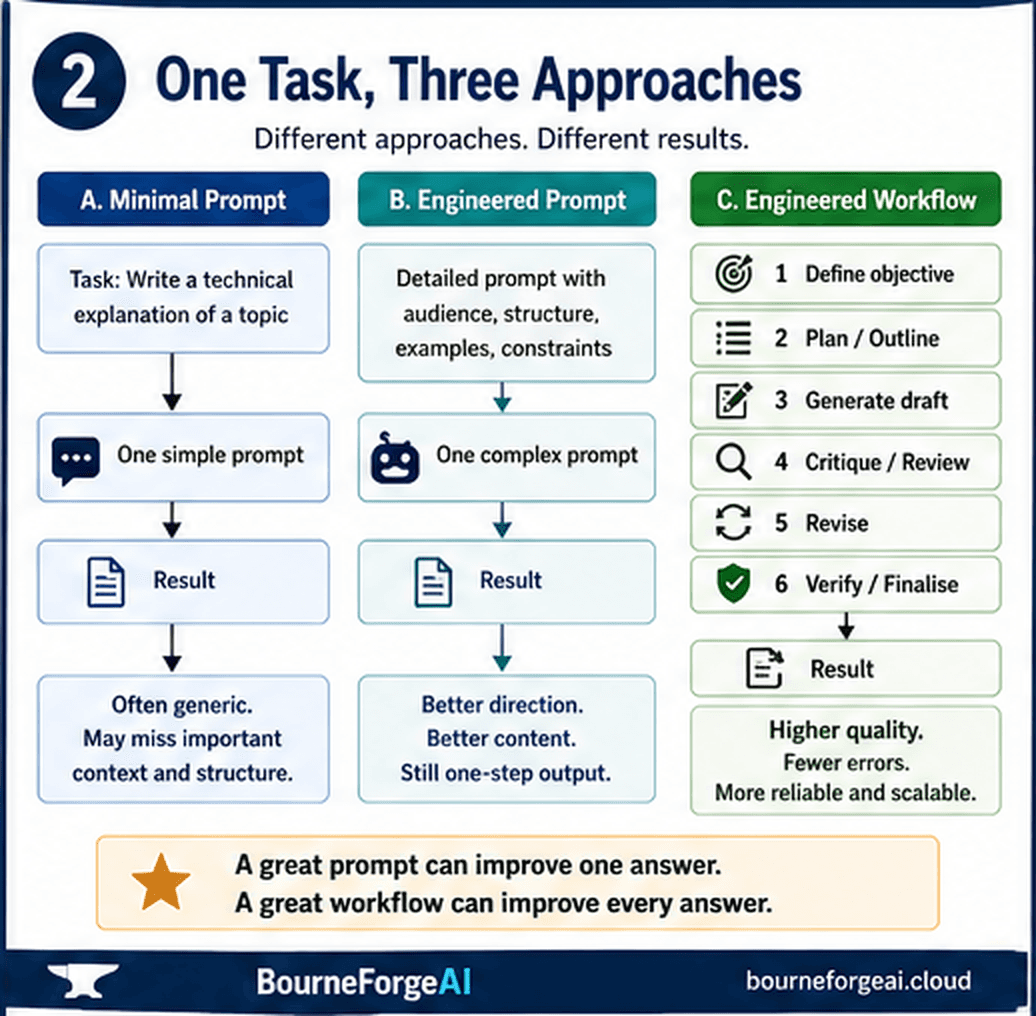
Workflow Patterns
Over time, certain workflow patterns emerge across many disciplines.
These patterns are not tied to any particular AI model.
Instead, they reflect effective ways of organising work.
Pattern 1: Plan Before Producing
Instead of asking for the final output immediately:
- 1Generate a structured outline.
- 2Review the outline.
- 3Identify missing sections.
- 4Expand one section at a time.
This simple change frequently produces more coherent documents because structural problems are identified before significant writing begins.
Pattern 2: Generate Before Judging
Human creativity is often inhibited by early criticism.
AI workflows benefit from a similar principle.
Generate ideas first.
Evaluate them later.
For example:
- produce five architectural options,
- compare their strengths,
- eliminate weaker approaches,
- refine the preferred design.
Separating generation from evaluation encourages broader exploration while avoiding premature optimisation.
Pattern 3: Independent Review
One of the most effective workflow improvements is introducing an explicit review stage.
After producing an answer, ask the AI:
Review the previous response as an independent expert. Identify inaccuracies, unsupported assumptions, omissions, or opportunities for improvement.
This creates a deliberate separation between creation and critique.
Although the same AI performs both tasks, changing the objective often uncovers issues that were overlooked during the initial generation.
Human review remains essential, particularly for high-stakes work, but AI-assisted critique can significantly improve first drafts.
Pattern 4: Compare Alternatives
Rather than asking:
What is the best solution?
Ask:
Produce three substantially different approaches. Compare their advantages, disadvantages, risks, and implementation complexity.
This encourages exploration instead of convergence.
It also exposes assumptions that may otherwise remain hidden.
Human-in-the-Loop Design
Despite impressive capabilities, current AI systems remain tools rather than autonomous decision-makers.
The most effective workflows deliberately reserve certain activities for human judgement.
Examples include:
- defining project objectives,
- interpreting business priorities,
- making ethical decisions,
- approving final publications,
- validating critical technical information.
AI accelerates these activities.
It does not eliminate the need for human responsibility.
Well-designed workflows therefore include explicit checkpoints where people review, question, and approve AI-generated work.
Context as a Workflow Asset
Many discussions about AI focus on context as something that belongs inside a prompt.
In reality, context is a workflow asset.
Consider a software project.
Relevant context may include:
- coding standards,
- architecture diagrams,
- API documentation,
- project requirements,
- previous design decisions,
- deployment constraints.
Attempting to compress all of this into one prompt is neither practical nor desirable.
Instead, workflow engineering determines:
- when context should be introduced,
- which context is relevant,
- how much context is useful,
- and when obsolete information should be discarded.
Managing context effectively often has a greater impact than rewriting prompts.
When to Start a New Conversation
One question experienced users frequently ask is:
Should I continue this conversation or begin a new one?
There is no universal answer.
Continuing an existing conversation is useful when:
- previous context remains relevant,
- the project is evolving,
- terminology has already been established,
- continuity matters.
Starting a new conversation is often preferable when:
- changing to a completely different task,
- exploring alternative approaches,
- eliminating accumulated assumptions,
- testing prompt variations fairly.
Understanding this distinction is an important aspect of workflow engineering.
The conversation itself becomes a design decision rather than an accident.
Designing for Repeatability
Imagine producing ten technical articles.
If each article requires rediscovering effective prompts from scratch, productivity remains limited.
Instead, workflow engineering encourages reusable processes.
For example:
Research Workflow
- Gather sources.
- Identify key themes.
- Generate questions.
- Produce summaries.
- Compare viewpoints.
Writing Workflow
- Outline.
- Section drafts.
- Editorial review.
- Technical verification.
- Style refinement.
- Final proofreading.
Code Review Workflow
- Explain requirements.
- Analyse architecture.
- Review security.
- Optimise performance.
- Improve documentation.
- Produce final implementation.
Each workflow becomes a template that can be adapted to future projects.
Rather than remembering prompts, you remember systems.
Automation Without Losing Control
As AI capabilities continue to evolve, it becomes tempting to automate increasingly complex tasks.
Automation is valuable.
Unsupervised automation is not always desirable.
A reliable workflow balances efficiency with oversight.
Routine formatting may be fully automated.
Fact checking may involve AI-assisted review followed by human verification.
Strategic decisions remain firmly under human control.
The objective is not to remove people from the process.
The objective is to allow people to concentrate on the decisions that genuinely require expertise, judgement, and accountability.
Building Workflows That Improve Over Time
Perhaps the greatest advantage of workflow engineering is that workflows evolve.
Each project reveals opportunities for refinement.
A review stage might identify recurring weaknesses.
A comparison stage may expose better alternatives.
An additional verification step could reduce errors.
Unlike individual prompts, workflows accumulate knowledge.
They become organisational assets rather than isolated conversations.
Over months and years, these systems become faster, more reliable, and easier to reproduce.
This is precisely how mature engineering disciplines evolve.
AI should be no different.
Key Takeaways
Prompt engineering improves individual interactions.
Workflow engineering improves entire systems.
Professional AI use is less about asking better questions and more about designing repeatable processes that consistently produce high-quality outcomes.
When prompts are viewed as components within a larger workflow, discussions about “the perfect prompt” become far less important.
The real competitive advantage lies in building workflows that combine human expertise, AI capabilities, iterative refinement, and objective evaluation into a reliable production system.
That is the essence of workflow engineering.
And it is where AI begins to move beyond conversation and into professional practice.
About This Book
This page is part of Prompt and Workflow Experiments: What Actually Improves AI Results?, an eight-chapter deep dive on reliable AI engineering.
More from the Notes
Short technical notes and observations, written up as experiments produce something worth documenting.
Was this useful?
Published