Beyond the Search for the Perfect Prompt
By Mark Bourne
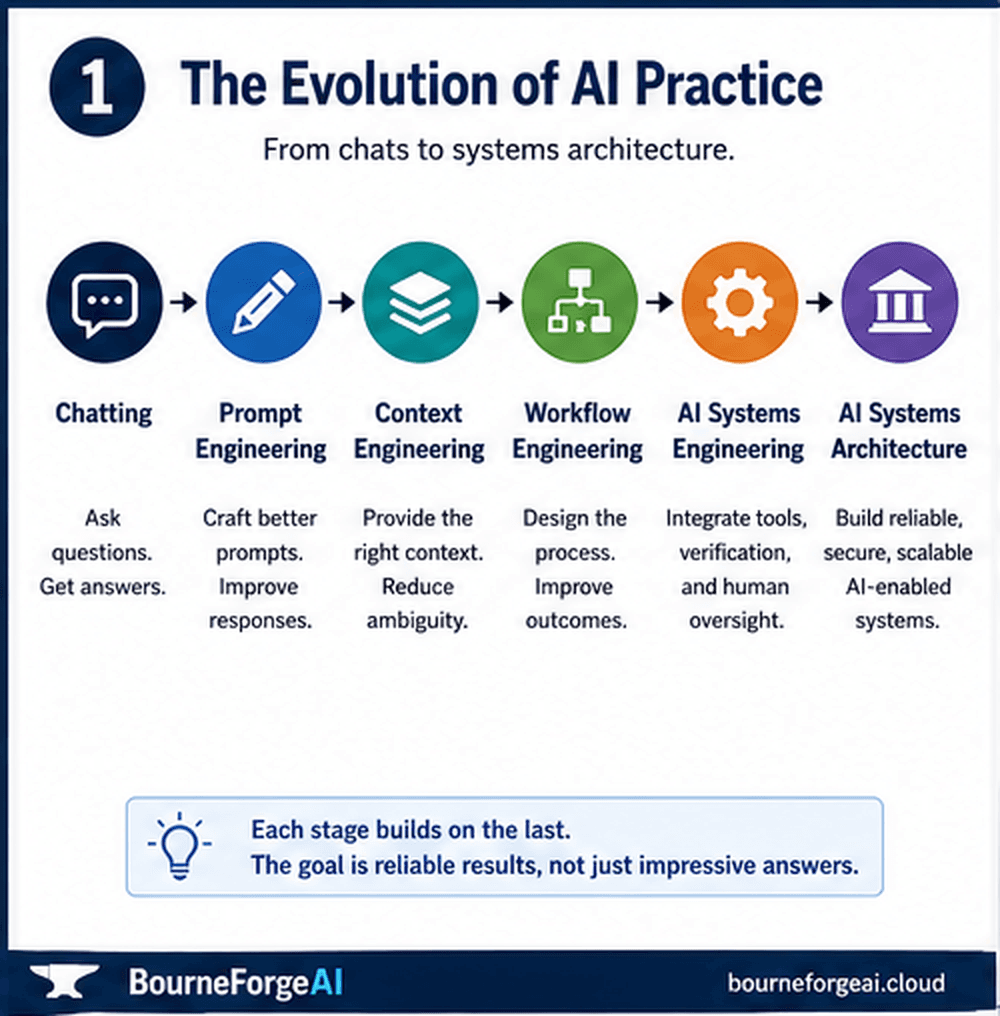
Introduction: Beyond the Search for the Perfect Prompt
Since the release of modern large language models (LLMs), one phrase has dominated countless blogs, YouTube videos, LinkedIn posts, and online discussions:
“Prompt engineering.”
Entire websites promise collections of “perfect prompts.” Social media is filled with claims that adding a few magic words will suddenly transform an average AI response into something extraordinary.
There is some truth behind these claims. The way you ask an AI to perform a task certainly influences the quality of its response. A well-structured prompt generally produces a better result than a vague instruction.
However, after thousands of interactions with systems such as Claude and ChatGPT, a different picture begins to emerge.
Experienced users eventually discover something surprising.
The prompt itself is rarely the most important part of the process.
Instead, the quality of the final result is usually determined by the entire workflow surrounding the prompt.
This distinction is subtle but profound.
A prompt is simply an instruction.
A workflow is a complete system.
Once you begin thinking in systems rather than individual prompts, your approach to AI changes completely.
Instead of asking:
“What's the best prompt?”
you begin asking:
“What's the most reliable process?”
That single shift in perspective separates casual AI users from professionals who consistently produce high-quality work.
Why Most Prompt Advice Falls Short
Search for “AI prompt tips” and you'll quickly encounter familiar advice:
- Be specific.
- Give the AI a role.
- Provide examples.
- Ask for step-by-step reasoning.
- Specify the desired format.
All of these recommendations are useful.
Yet they share one major limitation.
They focus on improving a single interaction.
Real-world work is rarely completed in a single interaction.
Writing a technical article.
Developing software.
Designing an architecture.
Analysing a financial report.
Reviewing legal documentation.
Planning infrastructure.
None of these tasks begin and end with one prompt.
Instead they involve dozens—or sometimes hundreds—of iterative conversations. The prompt is merely one component within a much larger process.
Imagine judging a bridge solely by the quality of its bolts while ignoring the foundations, supports, and engineering calculations.
It would be an absurd way to evaluate a bridge.
Yet this is effectively how many people approach AI.
They obsess over prompts while overlooking the workflow that surrounds them.
Thinking Like an Internet Architect
One of the guiding philosophies behind BourneForgeAI is that AI should be evaluated using the same principles that have been used to build reliable Internet infrastructure for decades.
Infrastructure engineers rarely ask questions such as:
“Will this configuration probably work?”
Instead they ask:
- What assumptions are being made?
- What happens if those assumptions fail?
- Can the process be repeated?
- Can another engineer reproduce the same outcome?
- How do we detect errors?
- What happens under unexpected conditions?
These questions focus on reliability rather than optimism.
The same mindset applies remarkably well to AI.
Consider two people writing an article using ChatGPT.
The first asks:
“Write me an article about cybersecurity.”
The second follows a structured workflow:
- 1Define the audience.
- 2Specify the desired outcome.
- 3Gather reference material.
- 4Ask for an outline.
- 5Critique the outline.
- 6Expand each section independently.
- 7Fact-check technical claims.
- 8Improve transitions.
- 9Edit for readability.
- 10Produce the final publication.
Both users interacted with the same AI.
Both may have started with similar prompts.
Yet their final outputs are likely to be dramatically different.
The difference wasn't the AI.
It wasn't even the opening prompt.
It was the workflow.
Prompt Engineering vs Workflow Engineering
This distinction deserves careful attention.
Prompt Engineering
Prompt engineering focuses on improving individual instructions.
Typical questions include:
- Which wording works best?
- Should the AI adopt a role?
- How much context should be included?
- Should examples be provided?
- Which output format is most useful?
Prompt engineering is valuable.
It improves local performance.
However, it only optimises a single step.
Workflow Engineering
Workflow engineering considers the complete lifecycle of a task.
It asks broader questions.
- How is information collected?
- How is context preserved?
- When should the AI critique its own work?
- Which tasks should remain human decisions?
- How is quality measured?
- How are revisions managed?
- Which model performs best at each stage?
Instead of optimising one instruction, workflow engineering optimises the entire production pipeline.
This is the difference between improving a sentence and improving a manufacturing process.
The Myth of the Perfect Prompt
One of the biggest misconceptions surrounding AI is that there exists a perfect prompt capable of solving every problem.
There isn't.
A prompt that performs exceptionally well for one model may produce mediocre results on another.
A prompt that works brilliantly today may perform differently after a model update.
A prompt designed for brainstorming may be unsuitable for technical documentation.
Context matters.
Audience matters.
Task complexity matters.
Model behaviour matters.
There are no universal prompts.
There are only prompts that work well within a particular workflow.
This is why experienced AI users rarely maintain a folder called “Perfect Prompts.” Instead, they build libraries of repeatable workflows.
For example:
Research Workflow
- Define objectives.
- Generate questions.
- Explore multiple perspectives.
- Compare findings.
- Produce a synthesis.
Writing Workflow
- Generate outline.
- Expand sections.
- Review structure.
- Improve transitions.
- Edit for clarity.
- Proofread.
- Final review.
Programming Workflow
- Define requirements.
- Design architecture.
- Review assumptions.
- Generate implementation.
- Test.
- Debug.
- Refactor.
- Document.
Notice that prompts appear throughout these workflows—but they are not the workflow itself.
From Conversations to Systems
One of the most significant changes experienced AI users make is moving away from isolated conversations toward structured systems.
Instead of opening a new chat for every task, they build repeatable processes.
They learn:
- when to create fresh conversations,
- when to continue existing ones,
- when to provide documentation,
- when to reset context,
- when to compare multiple models,
- and when human judgement should override AI recommendations.
Over time, AI stops feeling like a chatbot and starts behaving more like a collaborative engineering tool.
That transformation is not caused by better prompts.
It is caused by better workflows.
What This Article Will Explore
Throughout the remainder of this guide, we will move beyond simple prompting tips and examine AI from a systems perspective.
We will explore:
- How to design meaningful prompt experiments.
- Why fair comparisons require controlled variables.
- The difference between optimisation and overfitting.
- Practical workflow patterns used by experienced AI practitioners.
- Side-by-side comparisons of Claude and ChatGPT.
- Methods for evaluating AI output objectively rather than emotionally.
- Building a repeatable experimentation framework that improves over time.
The goal is not to help you write one better prompt.
The goal is to help you build a process that consistently produces better outcomes—regardless of which AI model you choose.
Because in the end, successful AI use isn't about discovering magic words.
It's about designing systems that are reliable, measurable, adaptable, and repeatable.
That is the mindset of workflow engineering.
And it is the foundation upon which the rest of this guide is built.
About This Book
This page is part of Prompt and Workflow Experiments: What Actually Improves AI Results?, an eight-chapter deep dive on reliable AI engineering.
More from the Notes
Short technical notes and observations, written up as experiments produce something worth documenting.
Was this useful?
Published